

Why Expandability Is Becoming a Must-Have Feature
When homeowners first shop for a home power storage system, they often focus on price per kilowatt-hour, brand reputation, and whether the system qualifies for tax incentives. Expandability often comes up as a secondary concern - if it comes up at all.
That's starting to change.
Energy Demand Keeps Growing
The National Renewable Energy Laboratory (NREL) projected in a 2023 report that by 2030, homes with EVs and heat pumps will require two to three times more battery storage capacity than a typical household did in 2020 to achieve the same level of energy independence.
In practical terms: a 10 kWh system that felt generous when you installed it might feel tight within three to five years if your energy profile changes.
Grid Reliability Isn't Getting Better Everywhere
Extreme weather events are becoming more frequent, and grid stress during peak periods has led to more rolling blackouts in states like California, Texas, and parts of the Southeast. Homeowners who initially bought storage primarily for utility savings are now prioritizing backup power duration - which means more capacity.
The Cost of Getting It Wrong
Here's what no one wants to hear: if you bought a home storage power system that doesn't support expansion, adding capacity often means purchasing an entirely separate system and having it installed alongside the first one. This adds cost, complexity, and sometimes compatibility headaches. In some cases, homeowners simply replace the original system altogether - an expensive lesson.
This is exactly why understanding expandability before you buy is so important. And if you already have a system, it's worth finding out now what your options actually are.
The Two Main Types of Home Power Storage Architecture
Not all battery systems are built the same way. There are two fundamentally different approaches to how storage capacity is structured, and they have very different implications for expansion.
Fixed-Capacity Systems
Some home power storage units are designed as complete, sealed products. The battery capacity is determined at the factory, and there's no manufacturer-supported way to add more. You might see these described with specific, non-variable numbers: "10 kWh unit," "13.5 kWh unit."
These systems often have real advantages - they can be simpler to install, easier to certify, and sometimes more competitively priced at the entry level. But if your energy needs grow, your options are limited to adding a separate, standalone system alongside the original, which creates its own coordination challenges.
Modular / Stackable Systems
Modular systems are designed from the ground up with expansion in mind. The base unit contains the inverter and control electronics, while battery capacity is added through additional modules - often called "battery expansion packs" or "battery stacks."
A typical modular home storage power design might start at 10 kWh and support expansion up to 30 kWh, 40 kWh, or even higher, simply by adding certified battery modules. The process is usually straightforward: a certified installer adds the new modules, updates the system firmware, and the BMS automatically recognizes and integrates the additional capacity.
This is the architecture that makes long-term flexibility possible.
High Voltage vs. Low Voltage - Why It Matters for Expansion
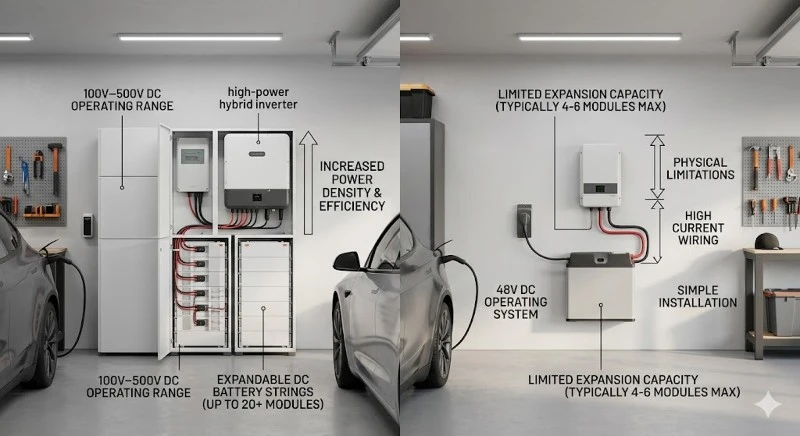
One technical distinction that significantly affects expandability is whether the system operates at high voltage or low voltage.
High voltage UPS home energy storage systems (typically 100V–500V battery strings) can support more battery modules per string and generally work more efficiently at higher states of charge. They tend to pair better with high-power inverters and are more commonly designed for expandable configurations.
Low voltage systems (typically 48V) are simpler and widely used in smaller installations, but they face more physical limitations when scaling up capacity.
If expandability is a priority, a high voltage home energy storage architecture is generally the better long-term foundation - particularly for homes with higher peak power demands.
How Capacity Expansion Actually Works
If you have a modular system (or are choosing one), here's what the expansion process typically looks like in practice:
1: Verify compatibility. Before anything else, confirm that the expansion battery modules are certified to work with your specific inverter and BMS version. This is non-negotiable. Mixing battery modules from different generations or different manufacturers can cause BMS errors, reduced performance, or in worst cases, safety hazards. Always buy expansion modules from your original home power storage manufacturer or a manufacturer-approved source.
2: Assess your inverter's capacity limit. Your inverter isn't just managing your battery - it controls how much power can flow in and out of the system. If you expand battery capacity significantly, but your inverter is already near its rated limit, you'll have more storage but won't necessarily be able to charge or discharge it faster. Some homeowners also upgrade the inverter at the same time as the battery expansion.
3: Professional site assessment. A qualified installer will check your electrical panel capacity, cable ratings, and the physical space available for additional modules. This is also when they'll confirm that your current wiring and breakers can handle the expanded system's peak output.
4: Module installation and commissioning. The new battery modules are physically connected - typically in a cabinet stack or wall-mounted rack alongside the existing unit. The installer then updates the system configuration, and the BMS runs an initialization process to calibrate the new total capacity.
5: System testing and performance verification. The installer should run the system through a charge/discharge cycle and confirm the full expanded capacity is accessible. You'll also want to check that your monitoring app reflects the updated system specs.
The entire process for a straightforward expansion is typically completed in a single day for most residential home storage power systems.
Key Questions to Ask Before You Commit to Any System
Whether you're buying your first system or evaluating an upgrade, these are the questions that separate a smart long-term decision from an expensive short-term one. Don't be shy about pushing your dealer or home power storage manufacturer for clear, written answers.
What is the maximum expandable capacity for this system? Get a specific number in kWh, not vague language like "highly expandable."
Are expansion battery modules from this manufacturer currently available to purchase? Some systems are theoretically expandable but expansion hardware is hard to source.
Will expansion modules available today be compatible with future firmware updates? You want backward compatibility guaranteed.
Does expansion void any part of the warranty? Factory-authorized expansions should not, but confirm this explicitly.
Is the inverter rated to handle the maximum expanded capacity? If not, what's the upgrade path?
What certifications do the expansion modules carry? Look for UL 9540A, IEC 62619, or equivalent regional standards.
What does a full expansion installation cost, labor included? Get this estimate upfront so it doesn't surprise you later.
Reputable home storage power factories and manufacturers should answer all of these without hesitation. Evasive answers are a red flag.
Worth knowing: The Energy Storage Association (ESA) has published guidance specifically addressing interoperability and expansion compatibility standards for residential storage. Their work on UL 9540 certification is helping establish clearer industry norms around what "expandable" should actually mean - good news for homeowners comparing options.
Real-World Example: Sunhingstones Modular Expansion in Practice
One of our customers in Phoenix, Arizona originally installed a Sunhingstones 15 kWh high voltage UPS home energy storage system in 2022. At the time, the household had modest evening load requirements and primarily wanted solar self-consumption optimization.
By 2024, the picture looked different: they'd added a Level 2 EV charger for a newly purchased electric vehicle, and summer air conditioning demand had pushed their peak usage significantly higher. The original 15 kWh system was cycling to near-zero on hot summer evenings before midnight.
Rather than replacing the system, they worked with their local Sunhingstones-certified installer to add two 5 kWh expansion battery modules, bringing total capacity to 25 kWh. The inverter capacity was already rated for this configuration, so no inverter upgrade was needed.
The expansion was completed in approximately six hours. Total downtime for the home: under 20 minutes during switchover. Post-installation, the household consistently maintained over 20% battery reserve through even the hottest summer nights, and EV charging was shifted entirely to solar surplus periods.
The homeowner's comment: "If we'd known we'd be adding an EV two years later, we might have started at 25 kWh. But it was genuinely reassuring to know we could grow into the system rather than replace it."
This is exactly what modular design is supposed to enable.
Common Mistakes Homeowners Make When Trying to Expand Their System
Even with the best intentions, expansion attempts can go wrong. Here are the most frequent missteps worth avoiding:
Buying expansion modules from a third-party supplier. It can be tempting when the price is lower, but mixing battery cells from different manufacturers - even with the same nominal voltage - creates BMS management problems that can reduce performance and potentially create safety issues. Always use manufacturer-approved expansion hardware.
Ignoring the inverter ceiling. More battery capacity is only useful if the inverter can actually move that energy in and out efficiently. Homeowners who add battery modules without checking the inverter limit sometimes find their "expanded" system charges no faster than before.
Skipping the professional assessment. Expansion isn't a DIY project. Even if the battery modules themselves are straightforward to connect, the electrical work, firmware updates, and safety commissioning need to be handled by someone qualified to work with high voltage home energy storage systems.
Assuming any system with "modular" in the marketing is truly expandable. Read the specification sheet. Some systems use the term loosely to describe aesthetic design choices (modular casing) rather than genuine electrical expandability. The key question is: can I add certified battery modules to increase kWh capacity after installation?
Not planning for where the expansion modules will physically go. Battery modules take up space. If your original system is wall-mounted in a tight utility room, make sure there's physical room to add modules before you order them.
What the Future Looks Like for Whole-Home Energy Storage
The residential storage market is growing rapidly. BloombergNEF reported that global residential battery storage installations increased by 67% year-over-year in 2023, with North America showing particularly strong growth. As more homeowners go all-electric, the demand for scalable, expandable whole home storage power solutions is only going to increase.
Manufacturers who build for expandability are building for where the market is going - not just where it is today. When you're evaluating a home storage power factory or manufacturer's product line, look at their roadmap: are they investing in backward-compatible expansion hardware? Is their BMS designed to scale? These are signals of a manufacturer thinking long-term.
At Sunhingstones, our entire product architecture - from the base unit through to the maximum-capacity configuration - is designed around a single principle: the system you install today should be able to meet the energy needs you'll have five years from now, without requiring a full replacement.
FAQ
1. What is a scalable home battery system?
A system that allows you to add battery modules later to increase storage capacity without replacing the original setup.
2. Can fixed-capacity systems be expanded?
No. Fixed systems are sealed units. Expansion usually requires a second system or full replacement.
3. How much can modular systems expand?
Typically from 10 kWh up to 30–40 kWh+, depending on inverter and system design.
4. Do I need to replace the inverter when expanding?
Not always. If the inverter supports higher capacity, you can add modules without replacement.
5. Is module expansion safe?
Yes, if you use manufacturer-certified battery modules only. Mixing brands is not recommended.
Not Sure What Capacity You Actually Need
That's exactly what our team is here to help you figure out. Whether you're choosing your first home storage power system or looking at expanding what you have, Sunhingstones offers free consultations - no commitment, no sales pressure.
Tell us about your home, your energy usage, and where you want to be in five years. We'll give you an honest assessment of what makes sense.
References
1.BloombergNEF, Energy Storage Market Outlook 2024: https://about.bnef.com/energy-storage
2.Energy Storage Association (ESA), Residential Storage Safety and Interoperability Resources: https://www.energystorage.org
3.Wood Mackenzie, U.S. Residential Energy Storage Monitor Q4 2023: https://www.woodmac.com