

Many camera brands add a fast-charge port and then discover the battery runs warm, the protection board keeps cutting out, and capacity fades sooner than expected. The problem is rarely that the battery "cannot charge fast." More often, the charge rate, the protection board settings and the charger were never matched to each other. If you are choosing a Lithium Polymer Battery JP802025 350mah PCB Added or a similar cell for a compact camera design, the checks below will help you avoid that trap
What Fast Charging Really Asks of a Camera Battery
Camera Use Is Different From Phone Use
Phone fast charging aims to fill the battery as quickly as possible. Cameras face two specific situations:
Top-ups between shoots: the user plugs in for a few minutes and expects real gains
Long video recording: the camera's own heat adds to the heat from charging, especially if the camera records while plugged in
Both put pressure on the cell, though in different ways: the first tests high-current tolerance, and the second tests heat handling.
Understanding C-Rate
C-rate is the charging current divided by battery capacity. For a 350mAh cell:
|
Charge rate |
Current |
Approx. time to full* |
Typical impact |
|
0.5C |
175mA |
about 2 to 2.5 hours |
Gentle, best cycle life |
|
1C |
350mA |
about 1 to 1.5 hours |
Common balance for compact devices |
|
2C |
700mA |
about 40 to 60 minutes |
More heat, needs a suitable cell and protection settings |
*Rough estimates for a standard constant-current then constant-voltage profile. Actual times depend on the charging IC and temperature.
WhySupports Fast ChargingDoes Not Mean the Same Thing Everywhere
Cell Design Sets the Ceiling
Electrode formulation, coating thickness and internal resistance determine how much current a cell can accept without excessive heat. Two cells with the same capacity can behave very differently at 2C.
The PCB Protection Board Sets the Safety Limits
A PCB protection board charge rate setting is not automatic. Check these three variables:
Overcharge cutoff voltage: commonly around 4.25V for 4.2V-class cells
Overcurrent threshold: it must sit above the charger's peak current, or the board will repeatedly cut out during fast charging
Temperature protection point: charging should stop when the cell gets too warm
Temperature Limits Matter
Lithium polymer cells are commonly charged within roughly 0 to 45°C. Charging below freezing is a known risk because it can damage the cell, so cameras used outdoors in winter need a design that limits or delays charging in the cold.
Choosing Between JP802025 and JP301324
Model numbers in this format are commonly read as thickness × width × length in millimeters. Please verify exact dimensions against the current datasheet before design freeze.
|
Item |
JP802025 |
JP301324 |
|
Approx. size (mm) |
8.0 × 20 × 25 |
3.0 × 13 × 24 |
|
Capacity |
350mAh |
90mAh |
|
Current at 1C |
350mA |
90mA |
|
Typical role |
Main cell for compact, action or kids' cameras |
Ultra-compact module or auxiliary circuit |
Where the 350mAh Cell Fits
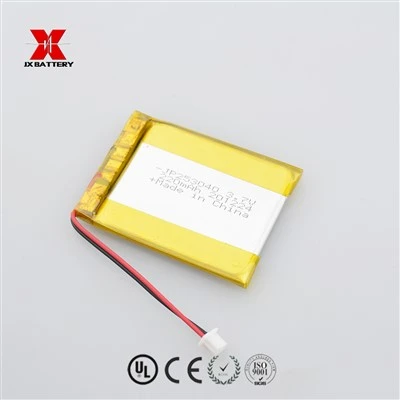
The Lithium Polymer Battery JP802025 350mah PCB Added suits small camera bodies, such as mini cameras, action cameras and children's cameras. Most full-size mirrorless and DSLR cameras use much larger main batteries, so this cell is not intended for them. At a 0.5C to 1C charge rate, it keeps heat manageable inside a small body.
Where the 90mAh Cell Fits
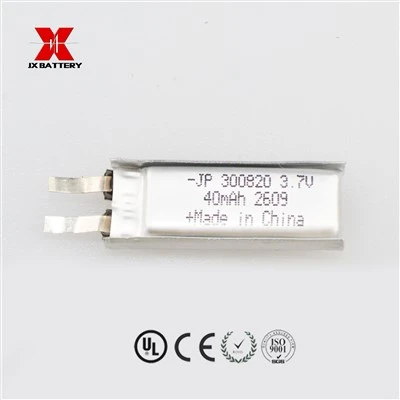
Lithium Polymer Batteries JP301324 90mah is a slim, low-capacity option. It suits ultra-compact modules or auxiliary circuits, and at 1C the charging current is only 90mA, so heat is easier to control. It is a different product tier and not a cheaper substitute for the main cell.
Confirming Fast-Charge Performance Before Mass Production
Cycle life at your charge rate: typical lithium polymer cells are often rated at roughly 300 to 500 cycles to 80% capacity under standard conditions, and higher charge rates tend to shorten that figure, so ask for data at the rate you plan to use
Protection board parameters in writing: overcharge, overcurrent and temperature thresholds matched to your charging IC
Dimensional tolerance: cells swell slightly over life, so check cavity margin and measured thickness across batches
Shipping compliance deserves early attention as well. Lithium cells are generally required to pass the UN 38.3 transport tests before moving through most air and sea channels, and many platforms now request the report. Suppliers who keep this documentation current, together with consistent batch records, make launches smoother.
FAQ
Q: Can a lithium polymer battery handle fast charging?
A: Yes, within limits. The cell design, the protection board and the charger must all be matched. Many compact devices use rates of roughly 0.5C to 1C, and higher rates need a cell and settings designed for them.
Q: Does fast charging damage a camera battery?
A: It does not cause instant damage when the design is correct, but higher charge rates generally reduce cycle life somewhat, especially in warm conditions.
Q: What is a safe charge rate for a lipo battery?
A: It depends on the cell specification. As a general guide, 0.5C to 1C is a common range, and anything higher should be confirmed with the cell's datasheet and test data.
Q: Why does my camera battery get hot while charging?
A: Some heat is normal. Excessive heat usually points to a charge rate too high for the cell, a mismatched protection board, or recording video while charging.
Q: Can the JP802025 and JP301324 be customized for my charging plan?
A: Protection board settings and dimensions can often be adjusted within a reasonable range. Changes to electrode formulation usually need new tooling and a longer lead time.
Does Your Camera's Fast-Charge Plan Need a Matched Battery
If you can share your charging IC specification, target charge time and body cavity size, we can review the match and arrange samples for testing. As a fast-charge lipo battery manufacturer, we are happy to look at your design and suggest a practical option.
Closing summary: For fast-charging cameras, look beyond the label. Match the C-rate to the cell, confirm the protection board thresholds, respect the temperature limits, and ask for cycle data at your real charge rate. A 350mAh cell suits compact camera bodies, while a 90mAh cell suits ultra-compact modules