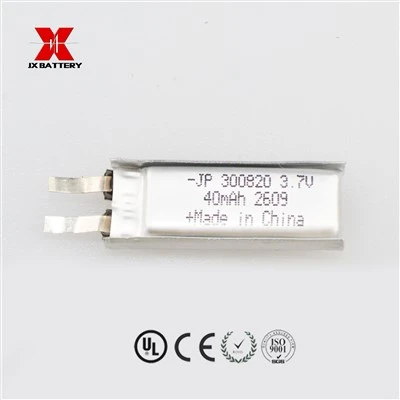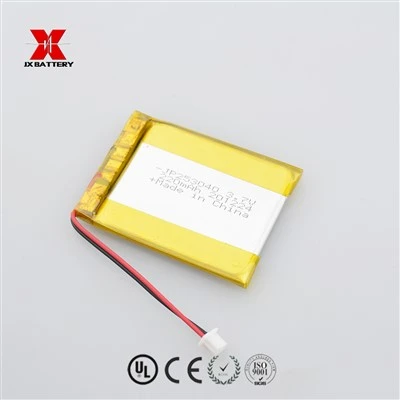


Many earbud brands print 10-minute fast chargeon the box, yet testing shows the case running hot, the earbuds topping up unevenly, and the case losing noticeable runtime after a few months. The cause is usually simple: the charging case battery has to be charged quickly and discharge into the earbuds, and the cell was selected for only one of those tasks. If you are evaluating a Lithium Polymer Battery JP802025 350mah PCB Added or a similar cell for a new design, the points below will help you avoid that trap.
Why a Charging Case Battery Is Harder to Choose Than an Earbud Battery
The Two-Way Workload
An earbud cell only discharges during listening and charges from the case. The case cell works in both directions:
Input side: it accepts current from a USB-C or wireless charger, ideally at a fast rate.
Output side: it feeds a boost converter that recharges the earbuds, sometimes while the case itself is still plugged in.
Both directions generate heat, and both happen inside a small plastic shell with almost no airflow.
How Capacity Usually Scales
Typical TWS earbud cells fall in roughly the 25-60mAh range, while charging cases usually carry 300-700mAh. A simple estimate shows why a 350mAh cell is popular:
Two earbuds at 40mAh each need about 80mAh per full recharge
A boost converter at about 85% efficiency leaves roughly 300mAh of usable output from a 350mAh cell
That gives around 3 to 4 full earbud recharges per case charge
Real results vary with earbud size and circuit design, so always confirm with your own measurements.
Key Parameters for a Fast-Charging Lipo Battery for Earbuds Case
A fast charging lipo battery for earbuds case should be judged on four numbers, not one marketing claim.
Charge Rate (C-Rate)
C-rate is the charging current divided by battery capacity. For a 350mAh cell, 1C equals 350mA.
|
Charge rate |
Current (350mAh cell) |
Approx. time to reach full charge* |
Typical impact |
|
0.5C |
175mA |
about 2 to 2.5 hours |
Gentle, best cycle life |
|
1C |
350mA |
about 1 to 1.5 hours |
Common balance for cases |
|
2C |
700mA |
about 40 to 60 minutes |
Higher heat, needs a suitable cell and protection settings |
*Rough estimates for a standard constant-current then constant-voltage profile. Actual times depend on the charging IC and temperature.
The PCB Protection Board
The protection board sets the safety limits: overcharge cutoff (commonly around 4.25V for 4.2V-class cells), overdischarge cutoff, overcurrent and short-circuit response. If the board's overcurrent threshold is lower than the charger's peak current, the case will repeatedly cut out during fast charging. This is why the phrase "PCB added" matters, and why the board parameters should be confirmed in writing alongside the cell specification.
Boost Efficiency and Discharge Rate
Losses in the boost circuit turn into heat and reduce usable capacity. A design that runs around 80% to 90% efficiency will deliver noticeably more earbud recharges than a poorly tuned one, using the same cell.
Cycle Life Under Fast-Charge Conditions
Typical lithium polymer cells are often rated at roughly 300 to 500 cycles to 80% capacity under standard conditions. Repeated high-rate charging tends to shorten that figure, so ask for cycle data collected at your intended charge rate, not just the standard datasheet curve.
Comparing JP802025 and JP301324 for Charging Cases
Model numbers in this format are commonly read as thickness × width × length in millimeters. Please verify exact dimensions against the current datasheet before design freeze.
|
Item |
JP802025 |
JP301324 |
|
Approx. size (mm) |
8.0 × 20 × 25 |
3.0 × 13 × 24 |
|
Capacity |
350mAh |
90mAh |
|
Nominal voltage |
3.7V |
3.7V |
|
Typical role |
Main cell for a standard TWS charging case |
Compact case or accessory module |
|
Approx. recharges for 2 × 40mAh earbuds |
3 to 4 |
under 1 |
Where the 350mAh Cell Fits
The Lithium Polymer Battery JP802025 350mah PCB Added suits mainstream TWS cases where the internal cavity has enough thickness. Its capacity gives several recharges, and at a 0.5C to 1C charge rate it keeps heat manageable for a plastic case.
Where the 90mAh Cell Fits
Lithium Polymer Batteries JP301324 90mah is a slim, low-capacity option. It is better suited to ultra-compact cases or accessory modules than to a full multi-recharge case, so treat it as a different product tier rather than a cheaper substitute.
Three Things to Confirm Before Mass Production
Fast-charge cycle test data: request results at your target C-rate and ambient temperature.
Protection board parameters in writing: overcurrent, overcharge and temperature-related thresholds matched to your charging IC.
Dimensional tolerance: cells swell slightly over life, so check the cavity margin and the measured thickness across batches.
Shipping compliance also deserves attention early. Lithium cells are generally required to pass the UN 38.3 transport tests before they can move through most air and sea logistics channels, and many marketplaces now ask for the test report. Suppliers who keep this documentation current, and who can show consistent batch records, make product launches much smoother.
FAQ
Q: Why does my earbud charging case get hot when fast charging?
A: Some heat is normal because charging and boost conversion both create losses. Excessive heat usually points to a charge rate too high for the cell, a mismatched protection board, or an inefficient boost circuit.
Q: Is a bigger charging case battery always better?
A: No. A larger cell adds thickness and weight, and it may not fit a slim case. Choose capacity based on how many earbud recharges you want, not on the biggest number available.
Q: How many times can a charging case recharge the earbuds?
A: For a 350mAh cell and earbuds of about 40mAh each, expect roughly 3 to 4 full recharges, depending on circuit efficiency.
Q: Does fast charging shorten the battery's lifespan?
A: Higher charge rates generally reduce cycle life somewhat, especially at warm temperatures. A properly matched cell and protection board keep that reduction modest.
Q: Can these cells be customized for my case size and charging plan?
A: Dimensions and protection board settings can often be adjusted within a reasonable range. Changes to electrode formulation usually need new tooling and a longer lead time.
Ready to Match a Battery to Your Charging Case
If you can share your internal cavity size and charging IC specification, we can check whether the JP802025 or JP301324 fits and arrange samples for testing. As a TWS charging case lipo battery factory, we are happy to review your design and suggest a practical option.
Closing summary: For a fast-charging earbud case, look beyond the "fast charge" label. Match the C-rate to the cell, confirm the protection board settings, account for boost efficiency, and ask for cycle data under your real charging conditions. A 350mAh cell suits standard cases, while a 90mAh cell serves compact designs