

Why GPS Trackers Are Particularly Sensitive to Battery Thickness and Shape
The internal cavity of a pet or asset tracker enclosure often leaves less than 3 mm of available space. The thickness of the JP802025 is typically controlled at 2.0–2.5 mm, while many conventional trackers reserve only 2.8–3.2 mm of internal height. After accounting for the waterproof gasket and antenna routing, the actual space left for the battery is frequently reduced to just 2.3–2.6 mm. Even a slightly thicker cell will not fit or will deform the housing.
Vehicle-mounted and portable trackers also differ significantly. Vehicle-mounted units can accept somewhat thicker, higher-capacity batteries because the installation position is relatively fixed. Portable or covert devices push thickness to the absolute limit while still needing room for the antenna. The three factors that ultimately determine the maximum usable thickness are:
Internal structure of the enclosure (reinforcing ribs and snap-fit features directly consume space).
Antenna routing and shielding layout (many designs place the antenna next to the battery, further reducing clearance).
Waterproofing structure (IP65/IP67 sealing rings and potting layers typically add another 0.3–0.6 mm).
If any of these three points is not confirmed in advance, it is very easy for a sample that is electrically qualified to fail to fit into the housing.
How to Choose Between 350 mAh and 90 mAh Capacities
Higher capacity is not always better; the choice must match the device and its actual usage pattern.
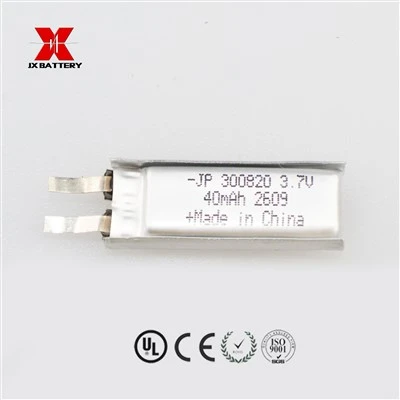
Lithium Polymer Batteries JP301324 90 mAh are better suited to ultra-compact or covert trackers. Their small volume and thin profile allow them to fit into pet collars or small asset tags, at the cost of shorter runtime. They are appropriate for low-frequency reporting scenarios in which the device spends most of its time in standby.
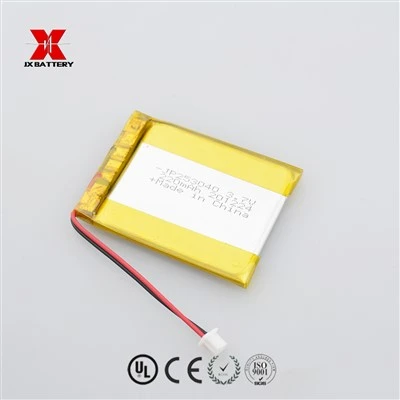
The 350 mAh option (represented by Lithium Polymer Battery JP802025 350 mAh PCB Added) is more suitable for asset tracking that requires multi-day runtime. The higher capacity significantly extends standby and positioning time under the same operating current, but the enclosure must first provide sufficient space. The key to an Ultra-Thin Lithium Polymer Battery for GPS Tracker is finding the right balance between thickness and capacity rather than simply pursuing maximum capacity.
Below is a simplified comparison (assumptions: GPS module sleep current ≈ 5–8 μA, single positioning event ≈ 15–25 mA·s, ambient temperature ≈ 25 °C):
|
Model & Capacity |
Typical Thickness Range |
Estimated Standby Time (Low-Frequency Reporting) |
Practical Runtime Reference (4–6 Fixes per Day) |
Suitable Applications |
|
JP301324 90 mAh |
1.5–2.0 mm |
7–12 days |
≈ 5–8 days |
Ultra-compact / covert trackers |
|
JP802025 350 mAh (with PCB) |
2.0–2.5 mm |
20–35 days |
≈ 15–25 days |
Asset tracking, multi-day runtime |
Actual runtime is also affected by temperature and signal strength. Capacity can drop 10–20 % in low-temperature environments, and poor signal conditions increase the number of positioning attempts, further shortening runtime. These figures are only reference values; the exact result depends on your firmware strategy.
Why a PCB Protection Board Is Not Optional for GPS Tracker Batteries
Many customers initially ask whether the protection board can be omitted to save thickness and cost. For GPS trackers we generally advise against this.
Over-discharge protection is critical for outdoor devices that may remain in standby for months between charges. If the voltage drops too low, the cell can suffer irreversible damage and capacity will decline rapidly thereafter. With a protection board, the circuit cuts off at the threshold and prevents this permanent degradation.
Typical protection parameters for a Custom Lipo Battery with PCB Protection Circuit are roughly: over-charge ≈ 4.25–4.30 V, over-discharge ≈ 2.5–3.0 V, with over-current and short-circuit thresholds set according to the cell and load current. These parameters significantly reduce safety risks during outdoor use.
In addition, UN38.3 and MSDS are basic requirements for lithium-battery transportation. Cells fitted with protection boards pass these tests more reliably and more easily meet cross-border logistics requirements. Recent tightening of lithium-battery inspections in international shipping means that compliant suppliers experience far fewer delays. Some customers who removed the protection board to save 0.2 mm of thickness later had shipments held, delaying the entire project.
Three Points Customers Should Confirm in Advance During Customization
To minimize the number of sample iterations and mold changes, it is recommended to clarify the following three items when requesting a quotation:
Dimensional tolerances: the actual usable internal cavity dimensions (L × W × T) and the maximum acceptable thickness deviation. Many projects ultimately stall on a ±0.1 mm tolerance.
Connector or lead-wire method: soldered wires, plug-in connectors, or FPC, including wire length and exit direction, all of which affect final assembly.
Certification requirements: whether UN38.3, IEC 62133, or specific target-market certifications are needed. Certification lead times and costs should be planned early.
Aligning these three points in advance greatly increases the probability that the first sample will be accepted.
FAQ
Q: How thin can an ultra-thin lithium polymer battery be while still remaining safe?
A: A practical and reliable lower limit for mass production is currently around 1.5 mm (corresponding to the 90 mAh class). Going thinner places sharply higher demands on packaging and the protection board, affecting both cost and yield. Safety always takes precedence over extreme thinness.
Q: Can the JP802025 and JP301324 models be further customized to my enclosure dimensions?
A: Yes. These are common starting sizes. In actual projects we frequently fine-tune thickness, length, or PCB placement to match the internal cavity, provided accurate three-dimensional space data is supplied.
Q: How long do tracker batteries typically last, and what is their cycle life?
A: Under normal operating conditions, cycle life is usually 300–500 cycles or more. Actual runtime depends on positioning frequency and sleep strategy. With low-frequency reporting, the 350 mAh version can last several weeks, while the 90 mAh version is better suited to shorter cycles. Low temperature or poor signal conditions will further reduce runtime.
Q: Must a custom battery include a PCB protection board, and how much does it increase cost?
A: For GPS trackers we strongly recommend retaining it. The cost increase is typically in the 10–20 % range, but it provides over-discharge protection and transportation compliance, which is more economical in the long run.
Q: How is consistency guaranteed between small-batch samples and mass production?
A: During sampling we provide multi-point thickness and capacity measurement data. For mass production we perform sampling inspection according to the agreed AQL standard, with particular emphasis on controlling thickness range and capacity dispersion within each batch.
Need a custom battery solution for your GPS tracker project
Please provide the internal cavity dimensions of the enclosure and your runtime requirements; we can then propose a sample solution and quotation. As a GPS Tracker Battery Manufacturer, we prefer to align the three critical points-thickness, capacity, and protection board-early in the project so that costly later revisions can be avoided