

Why a Single Cell Passing Does Not Mean the Whole Batch Is Consistent - The Real Sources of Batch Tolerance
Most thickness variation in soft-pack lithium polymer cells does not come from suppliers deliberately loosening tolerances. It comes from the processes themselves.
Heat sealing and edge punching are the two steps that cause the most problems. During aluminum-laminate heat sealing, even small differences in pressure, temperature, or dwell time can make the sealed edge locally thicker or create a slight bulge in the center. Typical within-batch variation in the industry runs around ±0.05 to 0.15 mm. If the punching accuracy is a bit off, the edge readings drift as well. We once saw a batch where 80 sampled cells all passed, yet roughly 15 % were scrapped during assembly because of center bulging - exactly this issue.
Whether the electrodes are wound or stacked also affects the thickness distribution differently. Wound cells tend to show more center thickness from uneven tension; stacked cells more often show edge variation from alignment accuracy. Typical ranges by process look like this:
|
Process |
Typical Within-Batch Thickness Tolerance |
Main Sources of Variation |
Practical Impact on Ultra-Thin Cells |
|
Heat-sealed Al laminate + punch |
±0.05–0.12 mm |
Heat-seal pressure & temperature fluctuation |
Center bulge and edge thickening often appear together |
|
Wound |
±0.08–0.15 mm |
Electrode tension, mandrel diameter differences |
Higher center thickness more common |
|
Stacked |
±0.04–0.10 mm |
Electrode alignment accuracy, separator thickness stack-up |
Edge variation more noticeable |
|
Structure with PCB protection board |
Additional local +0.3–0.8 mm |
PCB placement position & adhesive thickness |
Must distinguish bare-cell thickness from overall thickness including PCB |
These variations may all fall inside the single-cell tolerance, but once the range (max–min) inside the batch exceeds the assembly clearance, problems appear.
How to Test Dimensions and ThicknessFrom Sampling to Measurement Tools
A real battery thickness consistency test starts with the sampling plan, then moves to the right tools and measurement points.
On sampling, many people just grab a few cells to save time - that carries real risk. A more reliable approach is to follow AQL. For a lot size of 501–1200 pieces, normal inspection at AQL 1.0 requires 80 samples with an acceptance number of 2; at AQL 2.5 it is 50 samples with an acceptance number of 3. For ultra-thin cells we prefer AQL 1.0 because thickness directly affects assembly yield; relaxing to 2.5 noticeably raises the risk for the whole lot. Samples should cover different production shifts and different trays - do not pull everything from the same station, otherwise incoming quality inspection (IQC) becomes a formality.
For tools, anything with resolution coarser than 0.01 mm will not reveal true consistency differences. A digital micrometer or a dedicated thickness gauge both work; a standard caliper (0.02 mm) is almost useless on ultra-thin cells. When using a micrometer, keep the anvil parallel to the cell surface and avoid tilting. A thickness gauge is more convenient for quick multi-point checks. Whatever tool you use, measure in a controlled environment of 23 ± 2 °C and calibrate regularly with gauge blocks.
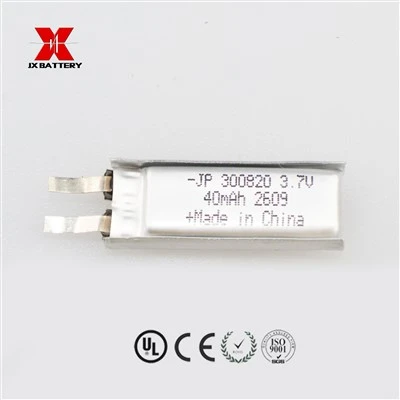
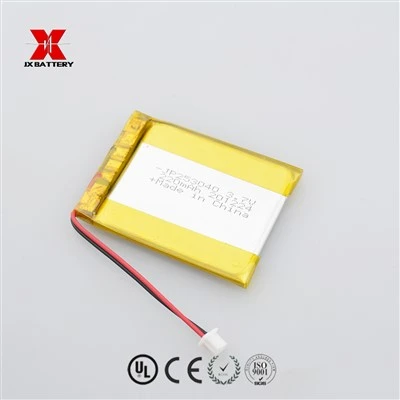
Different size ranges need different measurement focus. Take the Lithium Polymer Battery JP802025 350mah PCB Added as an example: capacity is relatively higher, so the center is more prone to bulging - the center point must be checked carefully, and the four corners cannot be skipped. For the smaller Lithium Polymer Batteries JP301324 90mah, the edges are more sensitive to punching and sealing thickness, so the four corners and sealed edges matter more; the center is relatively stable. Both sizes should follow the same multi-point procedure; only the acceptance limits are adjusted according to the actual assembly clearance. Dimension tolerance testing is less about how many times you measure and more about measuring the right locations.
How to Record and Judge the DataAvoiding Samples Pass but the Batch Fails
Single-point measurement is the easiest way to miss a local bulge. A more reliable method is to measure at least five points on each cell - center plus four corners - take the maximum as the cell's judgment thickness, and also record the five-point average and the range.
What really indicates batch consistency is the standard deviation and the range, not how pretty the individual numbers look. Here is a practical calculation example:
Suppose ten cells give these maximum thickness readings (mm)
2.85, 2.87, 2.84, 2.91, 2.86, 2.88, 2.85, 2.90, 2.87, 2.89
Average ≈ 2.872 mm, standard deviation ≈ 0.023 mm, range = 0.07 mm.
If the assembly clearance only allows 0.10 mm of variation, this set is fine.
Now change to another set: 2.82, 2.85, 2.88, 2.95, 2.84, 2.90, 2.83, 2.97, 2.86, 2.89.
The average is still similar, but the range jumps to 0.15 mm and the standard deviation rises clearly. Even if every single cell still falls inside the nominal tolerance, the whole-batch assembly risk is already high. The real risk in batch-to-batch variation of lithium batteries sits exactly in these "nice average, uncontrolled range" situations.
We normally set two layers of judgment:
The maximum thickness of each cell falls inside the nominal tolerance;
The within-batch range (max–min) does not exceed a pre-agreed limit (commonly 0.10 mm or 0.12 mm).
Watching only the single-cell tolerance and ignoring the range is the most common way to get caught out.
Three Details That Are Easy to Overlook During Testing
First, how long the cells sit between leaving the factory and actual assembly. Soft-pack cells left at room temperature can slowly release internal gas or develop slight swelling, pushing the measured thickness up by another 0.02–0.05 mm. It is better to re-measure within 72 hours of incoming or ask the supplier for thickness data linked to the time after leaving the factory.
Second, ambient temperature during measurement. When room temperature rises from 20 °C to 28 °C, micrometer readings can drift 0.01–0.02 mm. Only data taken in a temperature-controlled environment are comparable.
Third, the local thickness added by the PCB. The protection board plus adhesive can add 0.3–0.8 mm locally. You must clearly separate "bare-cell thickness" from "overall thickness including PCB"; otherwise the assembly clearance calculation will have a systematic error. For a model like the JP802025 with PCB, the report should list both values.
In the past two years, cross-border e-commerce has tightened batch-quality traceability requirements on 3C accessory supply chains, especially for battery products. More and more buyers now ask for batch test reports instead of just a model specification sheet.
Giving your actual sampling plan and assembly clearance requirements makes it far easier to match a suitable test method than simply asking "can you guarantee thickness consistency." As a Lithium Polymer Battery Supplier, we can provide a corresponding test-plan explanation or sample test report based on the batch inspection needs or AQL standard you supply, helping you lock down consistency risk at the incoming stage.
FAQ
Q: How do I test lithium polymer battery thickness consistency across a batch?
A: Follow an AQL sampling plan, measure five points (center + four corners) on each cell, record the maximum, average and range, then judge by the batch standard deviation and range. Looking only at whether single cells fall inside tolerance easily misses whole-batch risk.
Q: What causes thickness variation between battery batches?
A: Mainly fluctuations in heat-seal pressure and temperature, punching accuracy, tension differences in winding or stacking, and the local thickness added by the PCB. Typical within-batch variation in the industry is around ±0.05 to 0.15 mm.
Q: How many samples should I test per batch for dimension consistency?
A: For a lot of 501–1200 pieces, normal inspection at AQL 1.0 requires 80 samples. Larger lots scale up according to the standard tables. For ultra-thin cells we recommend AQL 1.0 rather than relaxing to 2.5.
Q: What's an acceptable thickness tolerance for ultra-thin lithium polymer batteries?
A: Single-cell tolerance is usually kept within ±0.1 mm, but the more critical figure is the within-batch range not exceeding 0.10–0.12 mm. The exact number still depends on your assembly clearance.
Q: Does PCB placement affect the overall thickness measurement of a lithium battery?
A: Yes, and the effect is not small. The PCB plus adhesive can add 0.3–0.8 mm locally. Always record both "bare-cell thickness" and "overall thickness including PCB" and list both values in the report so the assembly calculation stays accurate.