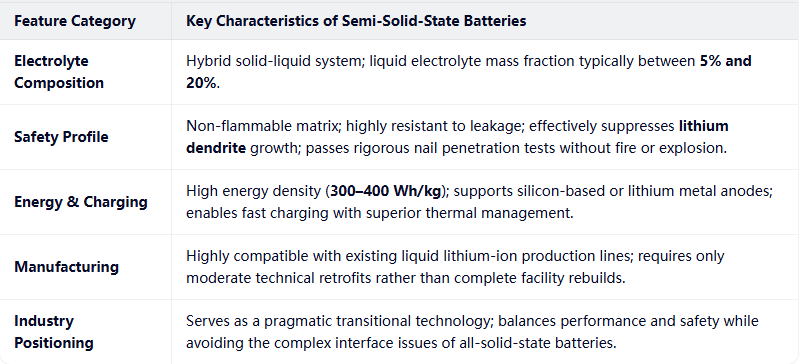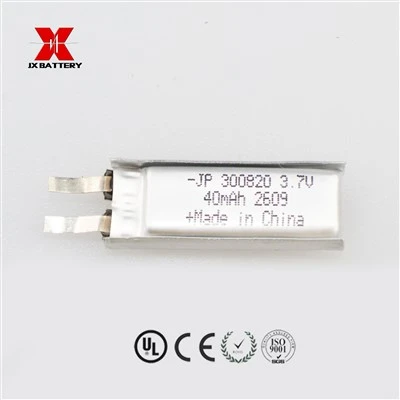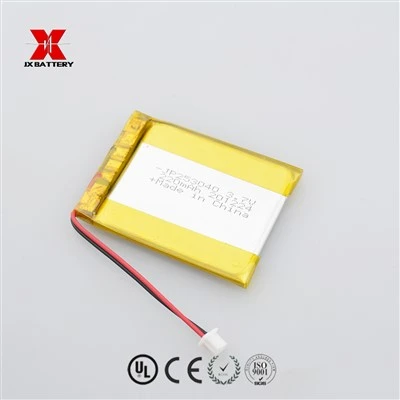


What's the semi-solid-state batteries?
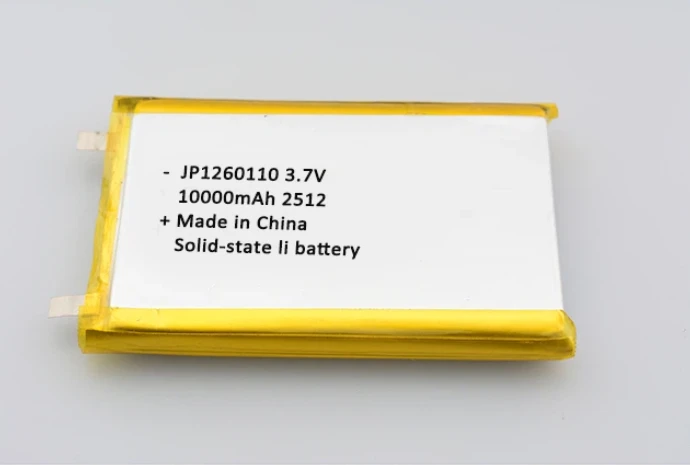
Semi-solid-state batteries represent a pragmatic transitional technology in the energy storage industry, bridging the gap between traditional liquid lithium-ion batteries and the future all-solid-state solutions. Their defining characteristic is the use of a hybrid solid-liquid electrolyte system. Unlike conventional batteries that rely entirely on volatile liquid electrolytes, semi-solid designs incorporate a solid electrolyte skeleton (often oxide-based) that acts like a "cage" to lock in a small amount of liquid electrolyte. According to emerging national standards, the mass fraction of the remaining liquid electrolyte typically ranges from 5% to 20%. This unique "solid-liquid coexistence" structure fundamentally alters the battery's performance profile, offering a balanced compromise between safety, energy density, and manufacturing feasibility.
The most prominent feature of semi-solid batteries is their significantly enhanced safety and thermal stability. The gel-like or quasi-solid electrolyte matrix is non-flammable and highly viscous, which drastically reduces the risk of leakage and thermal runaway compared to traditional liquid cells. Crucially, the solid component provides strong mechanical resistance that effectively suppresses the growth of lithium dendrites-microscopic needle-like structures that can pierce separators and cause internal short circuits in liquid batteries. In rigorous abuse tests, such as nail penetration or extreme挤压 (crushing), semi-solid batteries typically exhibit no fire, no explosion, and minimal temperature rise, making them highly attractive for safety-critical applications like electric vehicles and aerospace.
From a performance perspective, these batteries deliver superior energy density and fast-charging capabilities. The semi-solid electrolyte creates a stable electrochemical environment that supports the use of thicker electrodes and high-capacity materials, such as silicon-based anodes or lithium metal, pushing energy density to the 300–400 Wh/kg range. This translates directly to extended driving ranges for electric vehicles. Furthermore, the residual liquid electrolyte ensures efficient ion transport channels, allowing for high ionic conductivity. This enables rapid charging speeds without the excessive heat generation commonly associated with high-current charging in traditional liquid systems.
A defining industrial characteristic of semi-solid batteries is their manufacturing compatibility and cost-effectiveness. Unlike all-solid-state batteries, which require entirely new production lines and face immense challenges with solid-solid interface resistance, semi-solid batteries are designed as a "deep optimization" of existing liquid lithium-ion technology. They retain the traditional positive electrode, negative electrode, and separator framework, allowing manufacturers to utilize existing production equipment with only moderate technical modifications. This evolutionary approach significantly lowers capital expenditure, accelerates yield rate improvements, and makes large-scale commercialization economically viable in the near term, positioning semi-solid batteries as the dominant practical solution before all-solid-state technology fully matures.