

Why size parameters cause more trouble than capacity
A capacity miss usually means slightly shorter runtime. A size miss means the battery simply won't go in, or it forces the housing and creates assembly headaches. Smartphone internals are tight-0.2 mm can be the difference between a smooth fit and a full redesign.
Thickness tolerance is the one most people overlook
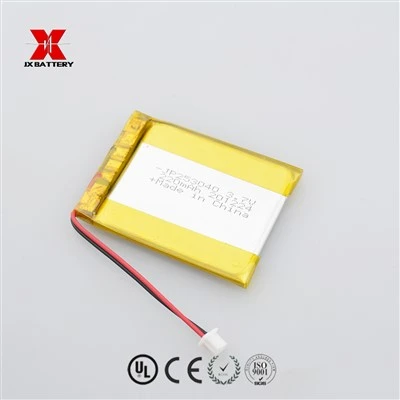
Many teams open the mold based on the nominal thickness only. Soft-pack cells expand a little during charge and discharge, and the protection board adds its own height. We've seen cases where a customer designed for 8.0 mm, the samples with the board measured 8.3 mm, and the entire batch pressed against the shell. The safer approach is to tell the supplier the maximum thickness after charge and discharge, not just the nominal value.
Length and width also need realistic assembly tolerance
|
Cell type |
Typical length tolerance |
Typical width tolerance |
Practical note |
|
Standard soft-pack |
±0.3–0.5 mm |
±0.3 mm |
Most common; leave extra room on tight designs |
|
With protection board |
±0.5 mm |
±0.4 mm |
Board and solder pads take additional space |
|
Irregular shape or special tab |
Confirm from drawing |
Confirm from drawing |
Send the structural drawing-numbers alone are risky |
The six core size parameters you should provide up front
Thickness × width × length, ideally matching common naming
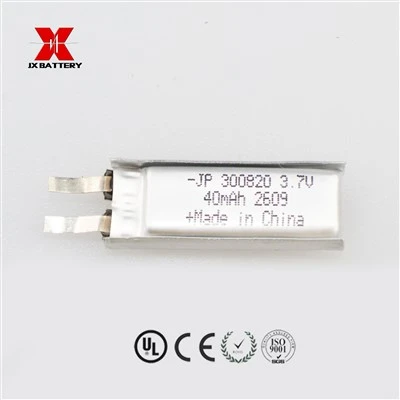
Many factories encode the dimensions directly into the model number. JP802025, for example, roughly means 8.0 mm thick × 20 mm wide × 25 mm long. When you say "I need a Lithium Polymer Battery JP802025 350mAh PCB Added," the supplier immediately understands both the size and the configuration. That's far clearer than simply asking for a "350 mAh soft-pack." When you're working on a custom lithium polymer battery size, give the target dimensions plus tolerance in one go.
Rated capacity and nominal voltage
Nominal voltage is almost always 3.7 V. Capacity and size are tightly linked-the available space sets the upper limit. A quick comparison:
|
Reference model |
Approx. dimensions |
Typical capacity |
Better suited for |
|
Lithium Polymer Batteries JP301324 90mAh |
3.0 × 13 × 24 mm |
90 mAh |
Earbuds, small wearables |
|
JP802025 350mAh |
8.0 × 20 × 25 mm |
350 mAh |
Smartphone backup, small IoT |
Don't just throw a capacity number. Tell the supplier the maximum space you have and the runtime you actually need-that's how proper battery capacity mAh selection happens.
Whether you need a protection board
For smartphones, the answer is almost always yes. Without a PCB protection circuit, overcharge and short-circuit risks rise, and many certifications become difficult. That's why models like JP802025 are commonly specified with "PCB Added." It's not optional for phone applications.
Connector type and wire length
JST, Molex, or bare leads? How long should the wires be? Industry practice usually allows ±2 mm on length. If the board connector sits in an awkward spot, mark the routing path as well. Confirming the connector and wire lead early avoids later rework.
Packaging style
Smartphones almost always use aluminum-laminated soft packs-light and formable. Hard cases offer more mechanical strength but add thickness, so they are rarely the first choice.
Certification requirements
For shipments to Europe or the US, UN38.3, MSDS, CE or UL are typically required. State these up front so the quotation and lead time stay accurate.
How to hand the size parameters to the supplier cleanly
A 2D structural drawing is ideal. If you only have a physical sample, measure several points with calipers-especially thickness-and note whether the measurement is at discharged or fully charged (maximum) state. When you provide lithium polymer battery dimensions, include the tolerance range.
Here's a ready-to-copy parameter checklist:
Target dimensions: thickness × width × length (mm), with tolerance
Rated capacity: ___ mAh
Nominal voltage: 3.7 V
Protection board required: Yes / No
Connector type + wire length
Packaging: aluminum soft pack / hard case
Certifications: UN38.3 / MSDS / CE / UL, etc.
Expected volume and sample quantity
Send these together and the supplier can evaluate much faster.
Three details that often get missed during customization
Tab position
If the tab exit direction conflicts with the mid-frame or screw bosses, assembly becomes awkward. Mark the tab location on the first drawing-changing the cell later is far more expensive.
Battery compartment chamfers and ribs
Many structural parts have chamfers or reinforcing ribs. A square-edged battery can jam or create local pressure points. Sharing the actual usable outline of the compartment is more reliable than just giving overall length, width and height.
Prototype first, then volume
Export certification requirements have tightened. Run a small sample batch, check fit, temperature rise and cycle performance, then move to mass production. This avoids discovering dimensional drift or certification issues on a full order.
Finding a supplier who can actually match these parameters
Quoting from capacity alone rarely produces an accurate offer. Providing a dimension list or physical sample makes both price and lead time far more reliable. A capable Lithium Polymer Battery Manufacturer will usually review your size requirements and propose a feasible sampling plan before you commit.
FAQ
Q: 1. What size parameters does a lithium polymer battery supplier need?
A: Mainly thickness × width × length (with tolerance), whether a protection board is required, connector type and wire length, packaging style, and certification needs. A structural drawing or physical sample makes the process much more accurate.
Q: 2. What does "PCB Added" mean on a lithium battery like JP802025?
A: It means the cell already has an overcharge, over-discharge and short-circuit protection board attached. Smartphones almost always require this for both safety and certification reasons.
Q: 3. Can I customize both size and capacity, like JP301324 90mAh vs 350mAh?
A: Yes. Available space sets the capacity ceiling. The supplier will recommend a suitable solution based on the maximum dimensions you can accept and the runtime you need.
Q: 4. What's the typical tolerance for battery thickness in mm?
A: Standard soft-packs are commonly ±0.2–0.3 mm. With a protection board, plan for ±0.3–0.5 mm. Always confirm against the agreed drawing, and pay special attention to the maximum thickness after full charge.
Q: 5. How long does custom LiPo battery sample production take?
A: Standard sizes usually take 7–15 working days. Irregular shapes or special certifications take longer. Providing clear size and certification requirements up front noticeably shortens the timeline.