

Thickness becomes the first hard limit on ultra-thin phones
A few years ago a typical phone still left 4–5 mm for the battery. Now many designs sit between 2.5 and 3.5 mm - more than 30 % less space. Every 0.1 mm you cut usually costs 3–5 % of capacity if the footprint stays the same. That tradeoff shows up clearly once you look at real energy density numbers:
|
Thickness range |
Typical energy density (mWh/cm³) |
What it means in practice |
|
4.0–5.0 mm |
500–580 |
Comfortable capacity |
|
3.0–3.5 mm |
450–520 |
Noticeable but still usable drop |
|
2.5–2.9 mm |
400–480 |
Runtime starts to hurt |
|
Below 2.5 mm |
Often under 400 |
Only viable for very light use |
These ranges arent theoreticalThey come from the cells we actually see in production.
How thickness and capacity really trade off - two real models
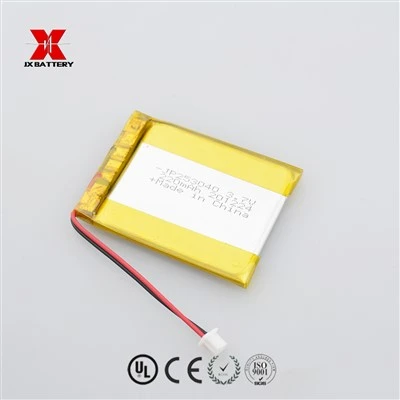
Start with a more conventional thickness. A Lithium Polymer Battery JP802025 350mah PCB Added sits in the roughly 8 mm class. At that height you still have enough room for active material, so 350 mAh is realistic without extreme process tricks. It works fine when the phone isn't chasing the absolute thinnest profile.
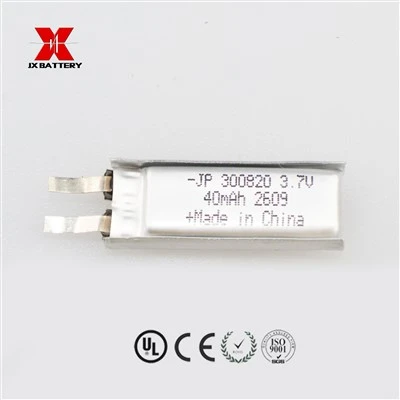
Now look at the thin end. Lithium Polymer Batteries JP301324 90mah live in a much smaller and thinner package. Capacity drops hard because there simply isn't enough volume left for the active materials. This is the kind of compromise ultra-thin designs often have to accept: you get the slim look, but you give up runtime.
The number that actually matters is energy density in mWh/cm³, not the raw mAh figure. A thinner cell with high density can still be useful; a thicker cell with poor density is just wasting the space you fought so hard to keep. Teams that only compare mAh numbers regularly pick the wrong cell for the available thickness.
What usually goes wrong with thin cells
Swelling room disappears fast. A normal soft-pack cell expands a little every charge cycle. In a 4 mm pocket that expansion is rarely a problem. In a 2.8 mm pocket it can push straight against the mid-frame. That's why the PCB protection circuit needs tighter over-charge settings on thin cells. On something like the JP802025 350mah with PCB Added you still have a bit of mechanical margin. On ultra-thin cells that margin is almost gone, so the protection parameters have to be stricter.
The sealing edge is another quiet killer. The drawing may say 2.8 mm, but the soft-pack seal is almost always thicker than the center of the cell. We have seen projects where the design called for 2.8 mm, the samples measured 3.1 mm at the seal, and the whole batch had to be reworked. Always ask for the maximum thickness including the seal, not just the nominal center value. A thin lithium polymer battery that looks perfect on paper can still fail fitment because of this.
Local bumps inside the compartment make things worse. Camera modules, shield cans or reinforcing ribs often stick into the battery space. The CAD model shows a clean 2.8 mm pocket; the physical mid-frame measures less. Measuring the actual lowest point on a real sample is far more reliable than trusting the drawing alone - especially for ultra-thin phone battery design.
What to tell the supplier when thickness is critical
Give them the measured thinnest point of the compartment, not the design nominal.
Tell them whether edge chamfers or shaped cut-outs are allowed so the cell can follow a curved mid-frame.
Ask that cycle-life testing is done at the full specified thickness. Thin cells are more sensitive to external pressure; a test run with extra free space can hide lifetime problems that only appear later.
Certification has also gotten stricter for cross-border 3C shipments in the last couple of years. Ultra-thin custom cells are more likely to be pulled for extra checks (UN38.3, CE, UL), so it pays to state the required certifications early.
How to get a real proposal instead of a hopeful quote
Saying "make it as thin as possible" almost never produces a usable answer. When you send the measured minimum thickness together with a realistic capacity target, a Lithium Polymer Battery Factory can come back with actual options rather than optimistic promises. A structural drawing or a simple thickness report usually gets you a concrete recommendation or sample plan much faster.
FAQ
Q: How thin can a lithium polymer battery be made?
A: Commercial soft-pack cells can go below 2.5 mm, but energy density and swelling control become the real limits. Below about 2.0–2.2 mm both capacity and process difficulty rise sharply for most phone use cases.
Q: Does a thinner battery always mean less capacity?
A: In the same footprint, yes. Less height means less active material. The battery thickness vs capacity tradeoff is real. The only ways around it are higher energy density or a larger footprint - both of which have their own constraints.
Q: Is a very thin lithium polymer battery safe to use in phones?
A: It can be, if the cell has a properly tuned PCB protection circuit, the mechanical design leaves room for normal swelling, and cycle-life testing is done under the actual compressed conditions. Thin cells simply leave less margin for error.
Q:What's the difference in capacity between JP802025 and JP301324 at different thickness levels?
A: JP802025 in the 8 mm class can realistically deliver around 350 mAh. JP301324 in a much thinner and smaller format typically sits around 90 mAh. The gap comes mainly from the available volume for active material.
Q: How do I confirm the real available thickness in my phone's battery compartment?
A: Measure the lowest point on an actual mid-frame sample with a depth gauge or micrometer, including any local protrusions. Design drawings almost always show a more optimistic number than the physical part.