

The earbuds play fine in the lab. Three hours later in real use they are already dead, while the charging case still shows charge left. In most cases the battery itself is not defective - the capacity was simply never split correctly between the two systems. This is the situation many TWS teams run into. Here's how people who have already gone through a few sample rounds actually pick capacity for a micro lithium polymer battery for earbuds.
The mAh number alone does not tell you much
The earbuds and the charging case are two completely separate batteries. Their requirements follow different rules.
Converting mAh into listening time also depends on how much current the chip really draws. From projects we have seen:
|
Chip power range |
Typical Bluetooth setup |
Rough playback from 90 mAh |
|
8–12 mA |
Basic 5.0 / 5.2, no ANC |
6–9 hours |
|
12–18 mA |
5.2 / 5.3 with light features |
4–6 hours |
|
Above 18 mA |
ANC on or higher features |
2.5–4 hours |
These are real-world ranges. That is why battery capacity vs listening time is never a simple division.
Two different jobs: the earbud cell and the case cell
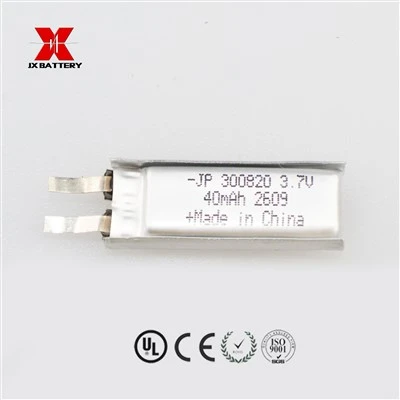
Space inside the earbud is extremely limited. Most designs end up with something in the Lithium Polymer Batteries JP301324 90mah class. At this size the absolute capacity is small, so the discharge rate often matters more than the headline mAh. We have seen cells that met the capacity target on paper yet voltage-sagged under peak volume or ANC load and shut the earbud down early. A micro battery that cannot hold the required current will fail even if the remaining capacity still looks fine.
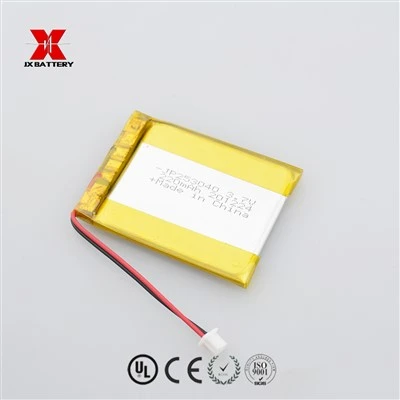
The charging case has more room. A Lithium Polymer Battery JP802025 350mah PCB Added is a common choice here. It can recharge the earbuds several times and still cover the case's own standby drain. Most brands aim for "full case recharges the earbuds 3–4 times." That usually means the case battery is sized at roughly 3–5 times the capacity of one earbud cell. When the ratio is wrong, users complain that the case still has power while the earbuds are already dead. TWS earbuds battery life is only as good as the weaker of the two systems.
Where these tiny cells usually cause problems
Discharge rate is the quiet killer. Small cells have limited continuous output. If the earbud draws higher current during loud passages or with ANC enabled, a cell that meets the mAh target can still sag and trigger shutdown. Matching the micro battery discharge rate to the actual peak load is more important than adding another 10 mAh.
A protection board is not optional. The earbud cavity is sealed and heat has nowhere to go. Over-charge or short events are more dangerous in that environment. Even a 90 mAh cell almost always needs proper PCB protection.
Cycle life also fades faster on micro cells. Because the volume is so small, the same absolute degradation shows up as a larger percentage loss. After about 300 cycles many of these cells retain only 80–85 % of original capacity. Larger cells in the same chemistry family usually age more slowly. If this is not planned for, field returns start appearing after a few months.
How to brief the supplier so you stop getting the wrong samples
Treat the earbud and the case as two separate requests.
Give actual power-consumption numbers from the target chip and use case, not only the desired playback hours.
Say clearly whether fast charging is required - fast charge changes both the cell preference and the protection design.
Certification for TWS products going to Europe and the US has tightened in the last couple of years. UN38.3 and IEC62133 checks now look more closely at batch consistency on micro cells, so it is worth stating the required certifications early.
Getting a real proposal instead of a hopeful quote
Just sending one total mAh number almost never works. When you list the capacity and discharge needs for the earbuds and the case separately, a Lithium Polymer Battery Wholesale supplier can come back with actual options rather than generic suggestions. A structural drawing or a short power-consumption note usually gets you a concrete recommendation or sample plan much faster.
FAQ
1. How many mAh does a bluetooth earbud battery need?
Most current designs sit between 30 mAh and 70 mAh per earbud. 40–50 mAh is common for mainstream models. The exact number depends on chip power, features such as ANC, and the target playback time.
2. Why does the earbud itself die faster than the charging case?
They are two separate batteries. The earbud cell is tiny and works continuously; the case cell is larger and only supplies charge from time to time. If the capacity ratio is wrong, the earbuds will always run out first.
3. Is 90mah enough capacity for a wireless earbud battery?
90 mAh is on the high side for a single in-ear bud and is more often used in larger or long-play designs. Typical TWS buds run 40–60 mAh. Whether 90 mAh is enough depends entirely on the power budget and the runtime target.
4. What's the typical capacity ratio between earbuds and charging case?
Most products aim for a case that can fully recharge the earbuds 3–4 times. That usually means the case battery is about 3–5 times the capacity of one earbud cell.
5. How does discharge rate affect micro lithium polymer battery selection for earbuds?
A cell can meet the capacity target on paper yet still fail if it cannot deliver the peak current the chip needs. Always match the continuous and peak discharge ratings to the real load profile, especially when ANC or high volume is expected.